Kidepo Valley National Park sits further from anywhere than any other park in Uganda, and this five-day journey is built to reward the effort of getting there. Along the way, a stop at Ziwa Rhino Sanctuary offers something genuinely rare: the only place in Uganda to see rhino in the wild, a reintroduction project run jointly by Rhino Fund Uganda and the Uganda Wildlife Authority.
Kidepo itself, spanning some 1,442 square kilometres of rugged, semi-arid valley between Uganda’s borders with South Sudan and Kenya, is often called the country’s most magnificent park precisely because so few visitors make the journey to see it. The Kidepo and Narus valley systems support over 77 mammal species and around 475 recorded birds, including lion, elephant, leopard, cheetah and buffalo among a wide cast of others, across open tree savannah that stretches in every direction. A genuine highlight follows in the form of a cultural visit to the Karamojong, cattle-herding people who share deep roots with Kenya’s Maasai and continue to live largely as they always have, an afternoon of performance and interaction that leaves a lasting impression.
A privately guided journey to Uganda’s most remote and rewarding wilderness, for travellers who want wildlife and culture found nowhere else in the country.
This itinerary suits adventurous travellers willing to commit to the long overland journey (or the optional flight back) for a genuinely different Uganda experience, rare rhino tracking at Ziwa, wildlife found nowhere else in the country's parks, and an authentic cultural encounter with the Karamojong. Well suited to repeat visitors who've done Uganda's primate circuit and want something further off the beaten path, and to travellers with a genuine interest in East Africa's pastoralist cultures.
Kidepo's peak season runs June to September and December, when roads are driest and most reliable for the long overland journey. March to May and November are quieter and wetter, though Kidepo's wildlife doesn't depend on migration timing, so game viewing remains genuinely rewarding regardless of season. Given the distance involved either way, guests choosing the overland option on Day 5 should budget real time for the return journey rather than treating it as a formality.
On arrival at Entebbe International Airport early in the morning, and after all arrival formalities, you’ll be welcomed by your safari guide and driven to Ziwa Rhino Sanctuary, home to Uganda’s only wild rhino population, in Nakasongola District along the Gulu highway toward Murchison Falls. The rhino reintroduction project here is a joint effort of Rhino Fund Uganda and the Uganda Wildlife Authority, and the sanctuary has become a genuinely popular stop for exactly this reason; it’s the only place in Uganda where rhinos can be seen in the wild.
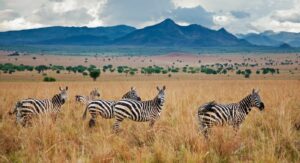
After an early breakfast, you’ll take a walking safari to see the white rhino before setting off for Kidepo National Park. Kidepo Valley spans some 1,442 square kilometres in Uganda’s Karamoja region, lying in rugged, semi-arid valleys between the country’s borders with South Sudan and Kenya, roughly 700 kilometres from Kampala. The park holds two major valley systems, the Kidepo and the Narus, mostly open tree savannah, with vegetation and wildlife varying between the two thanks to differing rainfall patterns. Gazetted in 1962, Kidepo hosts a genuine profusion of big game, over 77 mammal species and around 475 recorded birds, and is widely considered Uganda’s most isolated and most magnificent national park. You’ll arrive at your lodge later in the day for an overnight stay.
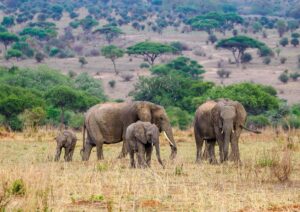
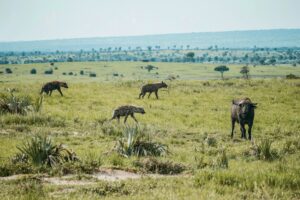
After breakfast, you’ll drive through the Narus Valley for a guided nature walk, with a genuine chance of spotting lion, elephant, leopard, bush duiker, jackal, bushbuck, bush pig, ostrich and buffalo, among others. After lunch, a game drive continues across Kidepo’s savannah landscape, extending in every direction and home to herds of buffalo, warthog, duiker, Jackson’s hartebeest, lion, leopard and cheetah, alongside roan antelope, waterbuck, eland, oribi and klipspringer. The park also holds Uganda’s highest concentration of endemic birdlife, including ostrich, kori bustard, vulture, pygmy falcon, hornbill and eagle among them. You’ll return to your lodge afterwards to rest.
Another morning game drive through the Narus Valley offers a further chance at species missed on previous drives, lion, leopard and the notoriously elusive cheetah among them. After lunch, you’ll visit the Karamojong community of northeastern Uganda, who share deep roots with Kenya’s Maasai and make their living largely as cattle herders, still living in a strongly traditional way. Traditional dress here favours black-and-red patterned cloth, and the women create striking beadwork, with the Karamojong living in small houses known as manyattas. A genuine cultural performance and real interaction with these accomplished cattle keepers rounds out the day; by the end of it, their pride and their measured pace in adapting to the wider world becomes something you’ll properly understand rather than just observe.
After an early breakfast, you’ll choose to either fly or drive back to Entebbe Airport for your departure flight home, bringing this memorable Uganda safari to a close.
Pricing
Rates vary by season, with low season (March to May, and November) from $1,500 per person, and peak season (June to September, and December) from approximately $1,900 to $2,100 per person.
Why travel with us
We keep group sizes intentionally small so every guest gets the attention, flexibility, and authenticity a safari deserves.
Our guides are born from the landscapes they lead. Decades of knowledge, sharp eyes, and a genuine passion for East African wildlife.
From comprehensive pre-trip briefings to 24-hour in-country support, your safety and comfort are always our first consideration.
Every safari we operate contributes to wildlife conservation and local community projects across Kenya, Tanzania, and Uganda.
You might also like
A 3-day Uganda safari to Bwindi for gorilla trekking and Albertine Rift birdlife, followed by a canoe ride on Lake…
A 3-day Uganda safari to Bwindi Impenetrable National Park for gorilla trekking, followed by a relaxed stay at Lake Bunyonyi.…
A 4-day fly-in Uganda gorilla trekking safari, Entebbe to Bwindi via Kihihi, with 2 nights full board at Buhoma Lodge.…